How Do You Construct a Relative Frequency Distribution
Getting 2 goals happens most often. The frequencies of A B C and D are 2 6 8 and 4.

How To Make A Relative Frequency Distribution Table Youtube
The ratio of the number of times a value of the data occurs in the set of all outcomes to the number of all outcomes gives the value of relative frequency.
. The key is adding up the relative frequencies less than or equal to a given valu. The sum of the relative frequency is 1. Total frequency 20 The relative frequencies of A B C and D are 01 03 04 and 02.
This statistics video tutorial explains how to make a relative frequency distribution tableMy Website. Making a relative frequency table is a two step process. Values and their frequency how often each value occurs.
A relative frequency is the ratio fraction or proportion of the number of times a value of the data occurs in the set of all outcomes to the total number of outcomes. Eqdfrac 29 6 48333 eq We take this. If you dont like the groups then go back and change the group size or starting value and try again.
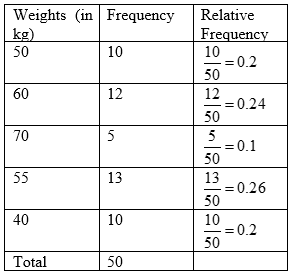
Construct a frequency distribution for the. Remember to find relative frequency you need to divide each number by the total number of values in the data set - in this case 50. This video covers how to make a relative frequency distribution chart.
Figure out your first relative frequency by divi. How did you do. Relative frequency is a measure of the number of times a particular value results as a fraction of the full set.
You can also express these as fractions or percentage. Now its much more understandable. Therefore to get the relative frequency we divide each frequency by 35.
The sum of all individual relative frequencies adds up to 100. Check out our tutoring page. Divide each frequency by the sum of the frequencies its useful to put the dollar sign between the letter and the number of the sum cell because it will be easy to multiply it.
To construct a frequency distribution table of the ungrouped data apply the following steps. The creation of the cumulative frequency distribution graph involves the following steps. How to Calculate Relative Frequency.
In order to find out how wide to make each group we take the range and divide it by the number of groups we want. Only once did they get 5 goals. The last group goes to 19 which is greater than the largest value.
From the table we can see interesting things such as. In the table select the columns that contain the names of values or categories and the column that contains the cumulative frequencies. FrequencyFAQhow find marginal frequencyadminSend emailDecember 2021 minutes read You.
Just divide each frequency by the total frequency and you have it. This video covers how to make a cumulative relative frequency distribution. Note that relative frequency distributions have the following properties.
This is the definition. In order to calculate relative frequency you need to know how many data points you have in your full data set. Relative Frequency Subgroup Count Total Count Let us learn now more here in this article.
Thats not too hard. Here is another example. This video covers how to make a frequency distribution chart.
The range for the data set is the longest time she spends reading minus the least time she spends reading. Create the cumulative frequency distribution table in Excel using the steps described in the previous section. If these conditions are not met then the relative.
Because we want to count each house only once these categories called classes are constructed so. Remember that the frequency simply shows how often a data point is on you list. Below is a frequency distribution table representing number of students absent in every grade.
Calculate the relative frequency distribution. The main thing is that it must include the largest value. To find the relative frequency of each value in the distribution we simply divide each individual frequency by 400.
Remember that in a relative frequency distribution we scale back the frequency using. How often 2 occurs 5 times etc and wrote them down as a Frequency Distribution table. I shortened it to rel.
The formula for a subgroup is. Make a table with the category names and counts. Enter the frequencies into the frequency distribution table.
In this case we would do. Format the cells to make them more comfortable to read. The sum of the relative frequency column should be 1.
Count your full data set. Find the range of the data The range R is defined as the difference between the largest data and the smallest data. In any table if total of last row or column is 100 then the given data in the table is of Joint relative frequency.
Add a second column called relative frequency. To provide more information we will construct frequency distributions by grouping the data into categories and counting the number of observations that fall into each one. Need help with a homework question.
The total frequency or the cumulative frequency in this case is 35. Each individual relative frequency is between 0 and 100.
Definition Of Relative Frequency Distribution Chegg Com

What Is A Relative Frequency Distribution Statology

What Is A Relative Frequency Distribution Statology
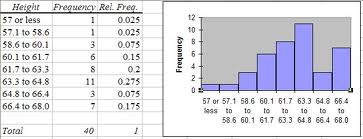
Relative Frequency Distribution Definition And Examples Statistics How To
No comments for "How Do You Construct a Relative Frequency Distribution"
Post a Comment